
When Does a Patient Need a Ventilator? Signs, Conditions and Warning Symptoms
By Admin · Content Admin
Learn when a patient may need a ventilator, including warning signs, medical conditions, ventilator support, risks, and ICU care at Reliance Hospital Islamabad.
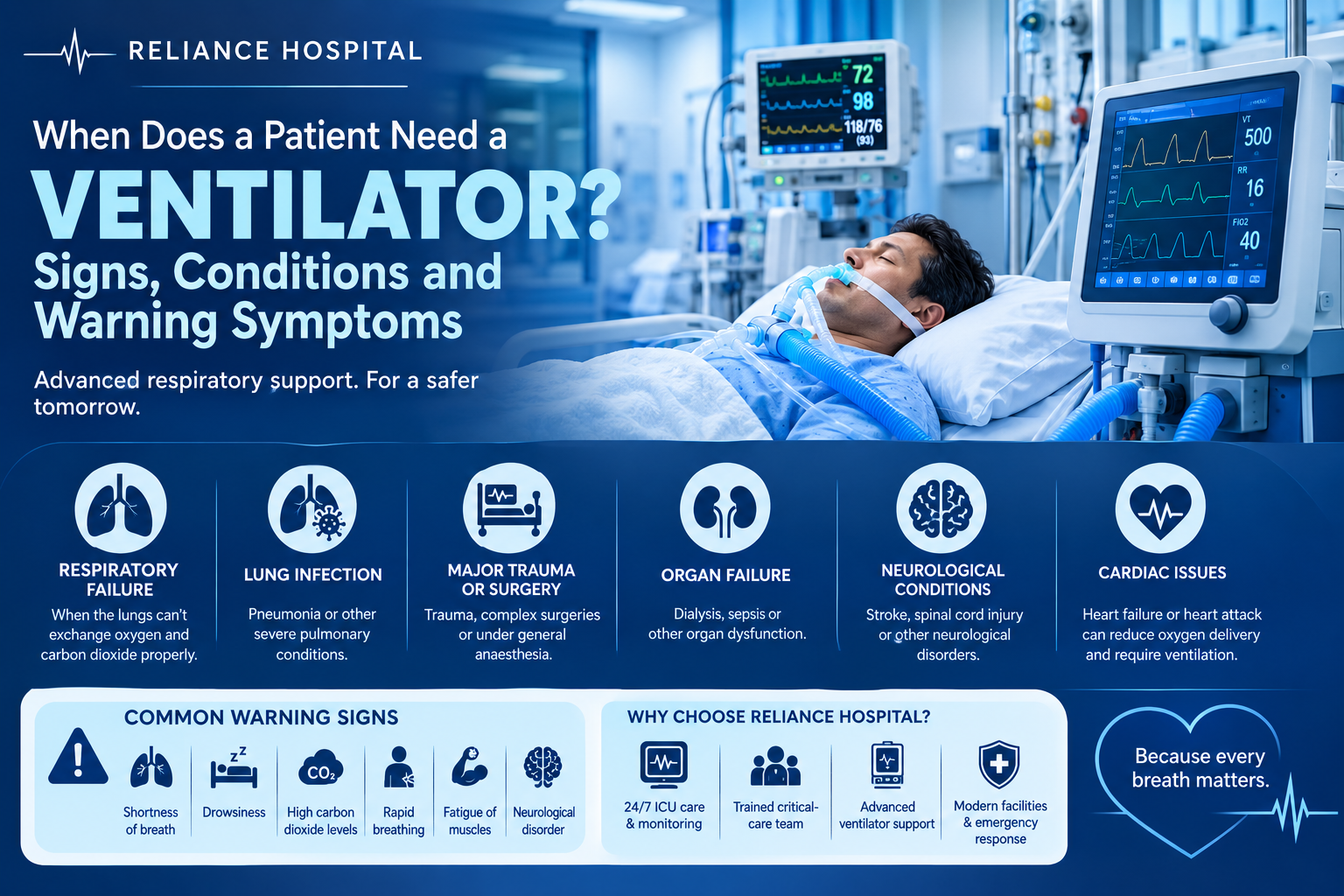
The patient needs ventilatior when he can't breathe on his own, and it is the most advanced invention in one of the life-saving inventions. The ventilator is used after monitoring the condition of the patient properly, his oxygen levels, CO₂ and overall health condition, as well as his history.
When there is respiratory failure, lung infection, dialysis, major trauma, any major surgery or any other organ failure, then a ventilator is used.
Ventilators can be invasive, involving a tube inserted into the windpipe, or non-invasive, using masks or specialised devices to support breathing. The ventilator needs continuous monitoring to prevent complications while providing respiratory assistance in stabilising the patient. Continuous monitoring helps staff to stop breathing temporarily when the patient's health is good enough to breathe independently.
It becomes necessary when someone cannot breathe adequately on their own, during the condition in which respiratory failure happens and oxygen levels drop or carbon dioxide builds up, or during surgery under general anaesthesia when normal breathing is suppressed. It highlights that conditions like Acute Respiratory Distress Syndrome, Chronic Obstructive Pulmonary Disease (COPD), stroke, pneumonia, sepsis or any neurological disorders.
What are the conditions that require ventilator support?
Following are the conditions in which the patient is moved to the ventilator:
The condition in which the lungs of the patient cannot exchange carbon dioxide and oxygen properly and the oxygen level in blood drops in this condition means the patient needs ventilator support. This can occur in pneumonia or any pulmonary disease or respiratory issues.
When patients go through the major surgeries, trauma or any severe infection such as sepsis, etc., they require ventilator support.
Any neurological disorder may lead a patient to a ventilator, such as injury to the spinal cord, stroke beacuse it weakens the muscles involved in breathing.
During the major surgeries, patients are placed temporarily on a ventilator for the oxygen support.
Cardiac issues, such as heart failure or heart attack, reduce the ability of the body to deliver oxygen, so this requires ventilation for stabilising the patient.
What are the signs that indicate the need for a ventilator?
Medical staff monitor the vitals and other health conditions of the patient before moving to the ventilator.
These signs are:
Neurological disorder
Insufficient supply of oxygen
High carbon dioxide levels
Rapid breathing
Drowsiness
Fatigue of muscles
How are patients monitored, and what are the risks of the use of a ventilator
Ventilators save lives by supporting patients who cannot breathe on their own.
Long-term use carries risks such as ventilator-associated pneumonia.
Injuries in the lungs happen from extended mechanical pressure.
Complications from immobility, like muscle weakness or blood clots.
Doctors aim to wean patients off the ventilator gradually once they can breathe independently.
Careful monitoring and timely weaning help ensure patient safety and recovery.
Ventilator Support at Reliance Hospital
For the respiratory support for critically ill patients, Reliance Hospital Islamabad provides the specialised team with the proper ventilator support. And close monitoring and critical care are done. In Reliance Hospital Islamabad, the team takes care of the patient in a very responsible manner, with 24/7 monitoring of patients, trained ICU nursing staff and other advanced patient monitoring. Other isolation facilities, diagnostic support and syringe pumps are present for the facilitation and support.
The ICU support at Reliance Hospital is 24/7 available for the patients with severe pneumonia, respiratory failure and neurological conditions as well.
This type of critical-care setup can be particularly important when a patient's respiratory condition is changing rapidly and requires continuous observation rather than occasional monitoring.
If you are facing conditions such as
Shortness of breath
Drowsiness
Inability to speak properly due to loss of consciousness
Blue or grey lips
Sudden respiratory deterioration
You can come to the Reliance Hospital's ICU system immediately.
FAQs
1. Does low oxygen always mean a patient needs a ventilator?
No. Low oxygen may initially be treated with supplemental oxygen or other forms of respiratory support. A ventilator is considered when breathing remains inadequate or the patient has other indications for mechanical ventilation.
2. What are the main signs that someone may need a ventilator?
Severe breathing difficulty, worsening oxygenation, excessive carbon dioxide, extreme respiratory exhaustion, confusion, loss of consciousness and inability to protect the airway are among the important warning signs.
3. Can pneumonia lead to ventilator support?
Yes. Severe pneumonia can cause respiratory failure and may require mechanical ventilation when the lungs cannot provide adequate oxygenation or remove carbon dioxide effectively.
4. When should a patient be taken to the emergency department?
Severe or rapidly worsening breathing difficulty, blue lips or skin, confusion, inability to speak normally because of breathlessness, loss of consciousness or absent normal breathing should be treated as emergency warning signs. If you see any of the signs from this you can immediately come to the reliance hospital islamabad.
Conclusion
When any sign is shown that indicates that the patient needs proper support, such as difficulty in breathing, pneumonia, respiratory failure, neurological injuries, and other critical illnesses, close monitoring and advanced respiratory support may be required. Reliance Hospital in Bahria Town, Islamabad, provides 24/7 ICU care with mechanical ventilator support, continuous patient monitoring, trained critical-care staff, and emergency response facilities for patients who require intensive medical attention. Its respiratory support services also include invasive ventilation and non-invasive support. When a patient develops severe breathlessness, confusion, bluish lips or skin, extreme exhaustion, or reduced consciousness, timely medical assessment is crucial. Having access to a properly equipped ICU and experienced critical-care team can help ensure that appropriate respiratory support is provided when it is medically required.