
When Does a Stroke Require ICU Care? Signs, Conditions and Treatment
By Admin · Content Admin
Learn when a stroke requires ICU care, including warning signs, critical conditions, monitoring, emergency treatment, and recovery support for stroke patients.
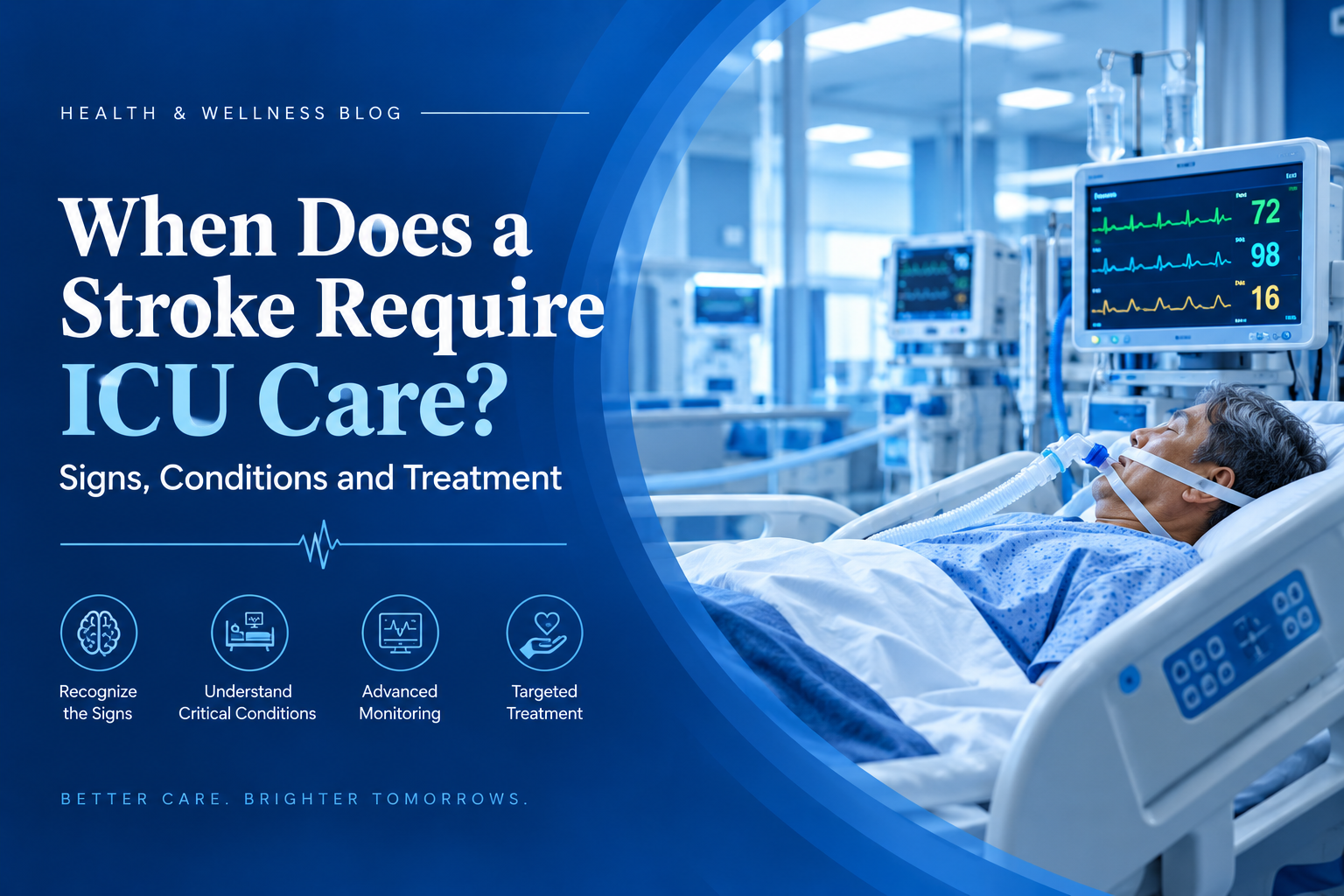
In a stroke there are sudden changes in speech, vision, and functioning of the brain, and the patient experiences unconsciousness; in simple words, it is a critical medical emergency. Some of them are treated in the regular ward, and in some critical cases patients need close observation and support in the ICU.
In which condition does a stroke require an ICU?
In the severe condition, the patient needs an ICU. The conditions, such as neurological symptoms and instability of blood pressure, should require continuous monitoring and rapid treatment. It mainly depends on the stroke’s severity and the overall condition of the patient and the medical history rather than the diagnosis of the stroke alone.
When the blood vessel in the brain is ruptured and the supply of blood is interrupted, then there are chances of stroke.
Two major types of stroke are:
Ischaemic stroke: A blood clot blocks blood flow to part of the brain.
Haemorrhagic stroke: A blood vessel ruptures, causing bleeding in or around the brain.
The treatments of both of them are different, but they require continuous monitoring.
Did every patient of stroke need ICU care?
Some patients suffering from stroke may become stable with the regular neurological care. So, every patient suffering from a stroke didn't need to be admitted to the ICU. But when the patients have developed complications, they need ICU-neurological care. Somehow it depends on some factors, such as neurological status, imaging findings, and the functioning of airways and breathing of the patient. The specialists used provide proper 24/7 monitoring of the patients for their stability and life support measurements.
In which condition do patients suffering from stroke require ICU?
Here are some conditions in which a patient needs ICU treatment:
Unconsciousness
Responsive
Increase in bleeding
Swelling in the brain
Difficulty in breathing
Haemorrhage
Svere blood pressure increase and decrease
Seizures
Problem in speech
What happens in the ICU after a stroke?
After the stroke, depending on the patient's health condition, a specialised ICU team monitors:
Response of pupil
Level of unconsciousness
Neurological monitoring
Levels of oxygen
Output in urine
Seizures
Pulse rate
Breathing rate
Balance in fluids
These examinations are performed frequently so that any changes are determined and the next treatment plan is planned accordingly. If the team examines that there is a need for treatment, it includes ventilation, respiratory support, blood pressure management, and swelling.
How Long Does a Stroke Patient Stay in the ICU?
There is no fixed duration for the stay in the ICU. It mainly depends upon the condition of the patient's health. The patients are monitored 24/7, and some of the patients need prolonged critical care if there is any swelling in the brain or breathing issue. If there is any neurological problem or any other complications, the patient's treatment plan is based on it.
Here are some signs that should be treated immediately if stroke patients develops:
Speech problems
Severe or worsened headache
Unconsciousness
Breathing difficulty
Seizures
Vomiting continuously
Pupil changes
Weakness
Stroke ICU care in Reliance Hospital Islamabad
For the critically ill patients, Reliance Hospital Islamabad provides services and gives 24/7 monitoring for the patients and specialised support. Here the ICU services include 24/7 critical care, ventilation support, respiratory monitoring, pulse determination and neurological observation.
Here the trained team includes the regular observation of neurological changes if there are any changes in the consciousness, pupil changes, any seizures, and monitoring of breathing or respiratory rate changes. The hospital states that this type of observation may be used for patients with stroke-related critical illness when ward-level monitoring is not sufficient.
The treatment is planned according to the patient's health condition and history.
Here the team decides, after monitoring the health of the patient, how long the patient should stay in the ICU; it requires mainly from 1 to 5 days in common. It would exceed depending on the severity of the stroke and the treatment.
Frequently Asked Questions
Does every stroke patient need ICU care?
No. Patients with mild or stable strokes may be appropriately managed in another suitable hospital ward. ICU care for the patient is generally considered when intensive monitoring or organ support is required.
What is the most common cause of death after a stroke?
The most common cause of death after a stroke depends on how much time has passed, but overall, recurrent stroke, heart disease, and pneumonia are the leading causes
How long can a stroke patient stay in the ICU?
A stroke patient typically stays in the intensive care unit (ICU) for 1 to 5 days, but the exact duration depends on the severity of the stroke and the medical treatments required
Does Reliance Hospital provide ICU care for stroke patients?
Yes. Reliance Hospital provides intensive care for critically ill patients who require continuous monitoring and specialised support. Its ICU services include neurological observation, continuous monitoring, ventilator and airway support, and management of complications such as seizures or reduced consciousness. The level of care is determined according to the patient's stroke severity and clinical condition.
Conclusion
The patient suffering from a stroke does not require an ICU, but it depends on the neurological condition, consciousness, swelling of the brain, bleeding inside the body, difficulty in breathing or any other condition that makes ICU care necessary.
The purpose of ICU treatment is not simply to provide closer observation. It allows medical teams to monitor neurological and vital functions continuously, respond rapidly to deterioration, and provide advanced support when necessary.
Reliance Hospital provides 24/7 ICU care in Rawalpindi with continuous bedside monitoring and specialised neurological observation for critically ill patients. Its ICU services include neurological assessment, monitoring for seizures and sudden neurological changes, airway and breathing support when required, and coordination with specialist teams.
Reliance Hospital's Neurology Department also provides stroke management, while the ICU team can provide critical-care support when a patient's condition requires a higher level of monitoring. For families looking for timely stroke and intensive care in the Rawalpindi-Islamabad area, proper medical assessment is essential so that the appropriate level of care can be provided according to the patient's condition.